A brilliantly simple eco mode in ERP: How e-invoicing saves trees and company budgets
Blog
An e-invoice does not have to be just a PDF in an email. In a properly configured ERP system, it can save paper, time, and costs while also removing unnecessary manual steps from the invoicing process.
A brilliantly simple eco mode in ERP: How e-invoicing saves trees and company budgets
Blog
An e-invoice does not have to be just a PDF in an email. In a properly configured ERP system, it can save paper, time, and costs while also removing unnecessary manual steps from the invoicing process.
Date: 6.7.2026
|
Posted by: Renáta Rybanská
Sustainability and ecology are widely discussed in modern business. We often imagine them as huge investments – solar panels on warehouses, a fleet of electric vehicles, or complex AI algorithms for managing server energy consumption. Sustainability in business itself is often reduced to marketing gestures.
However, real efficiency in ERP is hidden in something more prosaic: in the elimination of “manual touchpoints”. These are places in the process where a person must interfere with a data flow that should run automatically. What if the most effective solution is not hidden in complex algorithms, but in the radical simplification of processes that we have so far only “digitalized”, but not truly made more efficient?
Most ERP systems today can handle electronic invoices in various forms, but few use them for real systemic savings of resources. In most cases, we have degraded such an invoice into a “digital copy of paper” – we generate a PDF, send it by e-mail and consider the process complete. That is not digitalization; it is only the transfer of inefficiency from paper to software. This “digital paper” still requires a human touchpoint: someone has to open it, check it and manually rewrite it into the system, or “read” it through error-prone OCR. It is an inefficient link that slows down the entire chain. In a better case, it involves sending data structures that the receiving ERP can process.
The previous standard of an “e-invoice” (sending a PDF by e-mail) is in fact only “digital paper”. It is an image that your client’s computer cannot read. A person has to open it, check it and manually rewrite it into the system (or use OCR, which makes mistakes). If your “eco mode” has so far worked as a tool for “less printing and more e-mails”, integration with the Digital Postman turns it into a tool for system automation. The invoice is no longer an attachment that needs to be processed – it is a data package that the customer’s ERP system receives and posts without a single human intervention, if it is able to do so.
In addition, e-mail as an invoicing tool is inefficient. E-mails get lost in spam, attachments are too large, and servers are unnecessarily burdened by repeated sending (because the invoice did not arrive). At the same time, it is still true that most ERP systems today work passively – they simply wait until you do something.
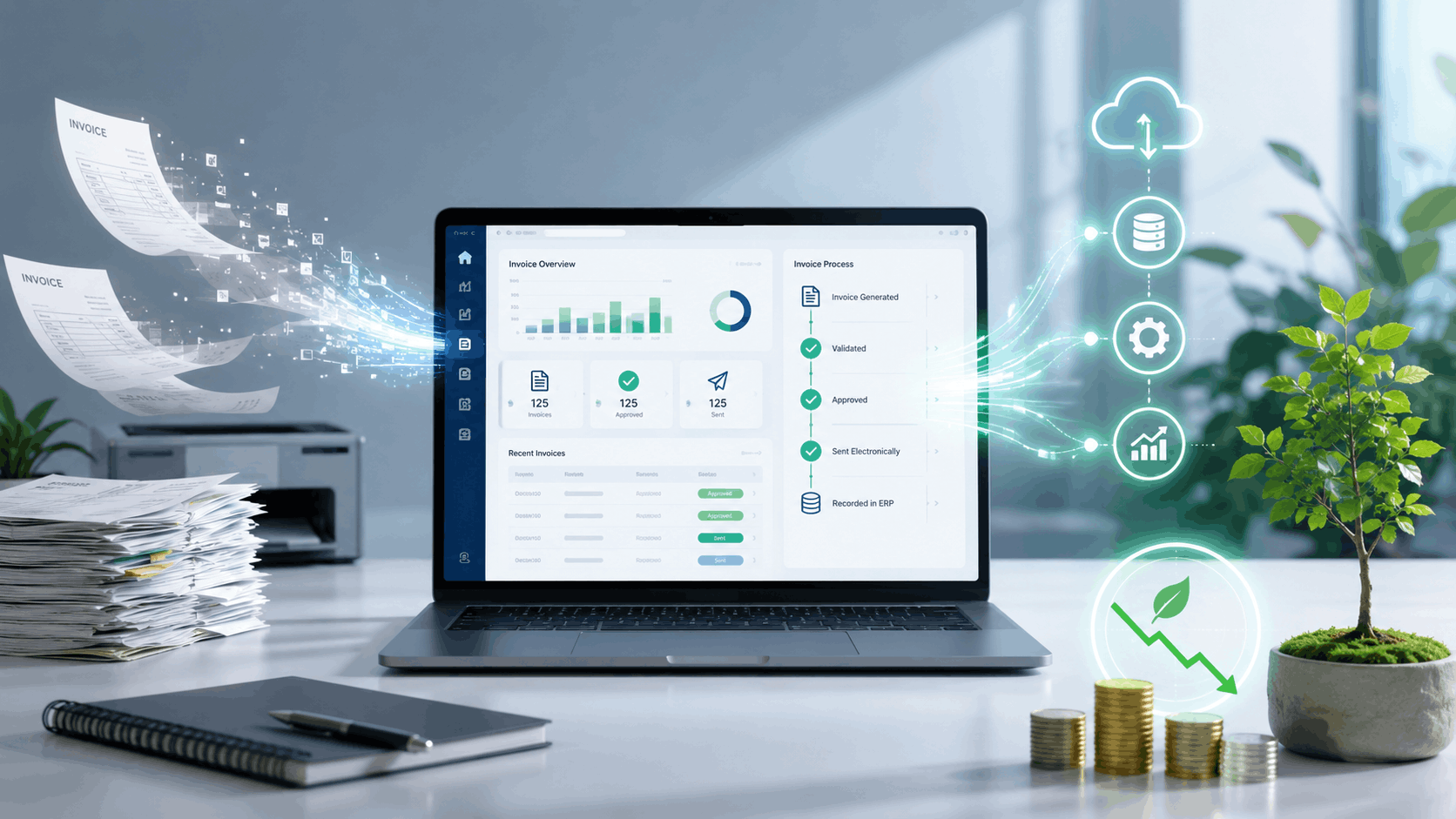
E-invoicing in an ERP system helps reduce paper consumption, limit manual interventions and save costs.
Why does it matter?
“Best practice” in the business of digitalization has long emphasized that the least efficient link in the chain is the one where data has to move from digital form to physical form and back again. Every such “touchpoint” is expensive, increases error rates and burdens resources. If your ERP system eliminates this necessity as part of its “eco mode”, you are not just making an eco-gesture. You are optimizing the operational architecture of your company. The fewer human touchpoints a process has, the more resilient, faster and naturally more resource-friendly the entire chain becomes.
What does “eco mode” consist of?
If you activate a truly digital process with your ERP, the document is not only issued – it is practically immediately “in circulation”; you have implemented the right kind of digitalization. In the case of e-invoicing, when the system can invoice and deliver the document without anyone having to touch it, operational efficiency rises to the maximum.
A good ERP actively manages the process so that the printer is not the first choice. It automatically communicates with carriers and the customer, eliminating the “paper brake”. The ERP system does not perform magic in the background, but actively changes the behavior of the system and the users themselves towards the absolute minimum of digital and physical waste.
Digital transformation is not about how much paper we have replaced with e-mails. It is about how many unnecessary steps we have completely removed from the system.
An e-invoice in the PEPPOL (Pan-European Public Procurement On-Line) format is not just another invoice format. It is an infrastructure that changes the rules of the game. If your “eco mode” has so far worked as a tool for “less printing and more e-mails”, PEPPOL integration turns it into a tool for system automation.
Why does e-invoicing change the rules of the game? Because it replaces “sending files” with direct communication between ERP systems.
If you turn on “eco mode” in your ERP system, you are not only saving trees. You are optimizing data flows that today cost companies tens of euros in unnecessary administration, because digital transformation is not about how much paper we have replaced with e-mails. It is about how many unnecessary steps we have completely removed from the system.